Why Woods Still Sells Traditional British Kitchen Linen
Woods still sells traditional British kitchen linen because my father refused to let it go when the British textile industry collapsed in the 1980s. Our Irish linen dishcloths, glass cloths and instant dryers are still woven in Northern Ireland to the old specifications, and they last well over a year in daily use.
What happened to British kitchen linen?
At the start of the 1980s, a shop like ours had a choice of suppliers for every cloth in the kitchen. By the end of it, most of them had gone.
It is worth being precise about what closing means, because it is not what people assume. A mill does not simply stop and reopen somewhere cheaper with the same product. What disappears is the specification: the particular yarn, the particular set of the loom, the finishing routine that took years of small corrections to arrive at. When that is gone it is gone, and what returns under the same description is thinner, made from a lower grade of fibre, and gives up after a few months.
My father made the other choice, and he has talked about why more than once:
"I've talked before about the demise of the British textile industry in the 1980s and so many names disappeared and one of the things that I was passionate about and we've always been passionate about is our traditional kitchen linens."
The arithmetic supports him. A cloth that lasts a year at nine pounds is cheaper than a cheap cloth that lasts a month, and a shop that intends to still be here in fifty years cannot afford to sell the second one.
Why does a linen dishcloth outlast a supermarket one?
Because of one word on the specification: line.
The Woods Famous 100% Linen Dishcloth has been made exclusively for us for over a century, it is woven in Northern Ireland, and it is made from line yarn rather than tow.
Line is the long, combed flax fibre, the same grade that goes into fine bed and table linen. Tow is the short waste left behind after combing, and it is what almost every inexpensive linen cloth is made from. A tow cloth sheds, greys, goes limp and starts to smell within weeks. A line cloth does not.
In use that means no fluff on a wet glass, no residue on a dried plate, real resistance to grease, and the ability to take bleach without collapsing. It is 46cm square, which is larger than it looks in the packet, and the weave is deliberately open so it lifts crumbs rather than pushing them around.
Our own longer piece on it, what makes the Woods Irish linen dishcloth so famous, goes further into the flax itself.
Why does a glass cloth have a stripe down the middle?
So that nobody uses it for anything else.
That is the genuine reason, and it survives from an era when kitchens ran on systems rather than habits. A glass cloth that has wiped a worktop is no longer a glass cloth, because it now carries grease, and grease is what puts smears on a wine glass. The coloured centre stripe is there so that the cloth can be identified across a busy kitchen and kept for one job.
The material does the rest. As my father puts it:
"So linen is more absorbent than cotton, but you don't actually often see linen pile towels."
A terry towel is looped, and loops leave lint on glass. A flat linen weave lifts water and leaves nothing.
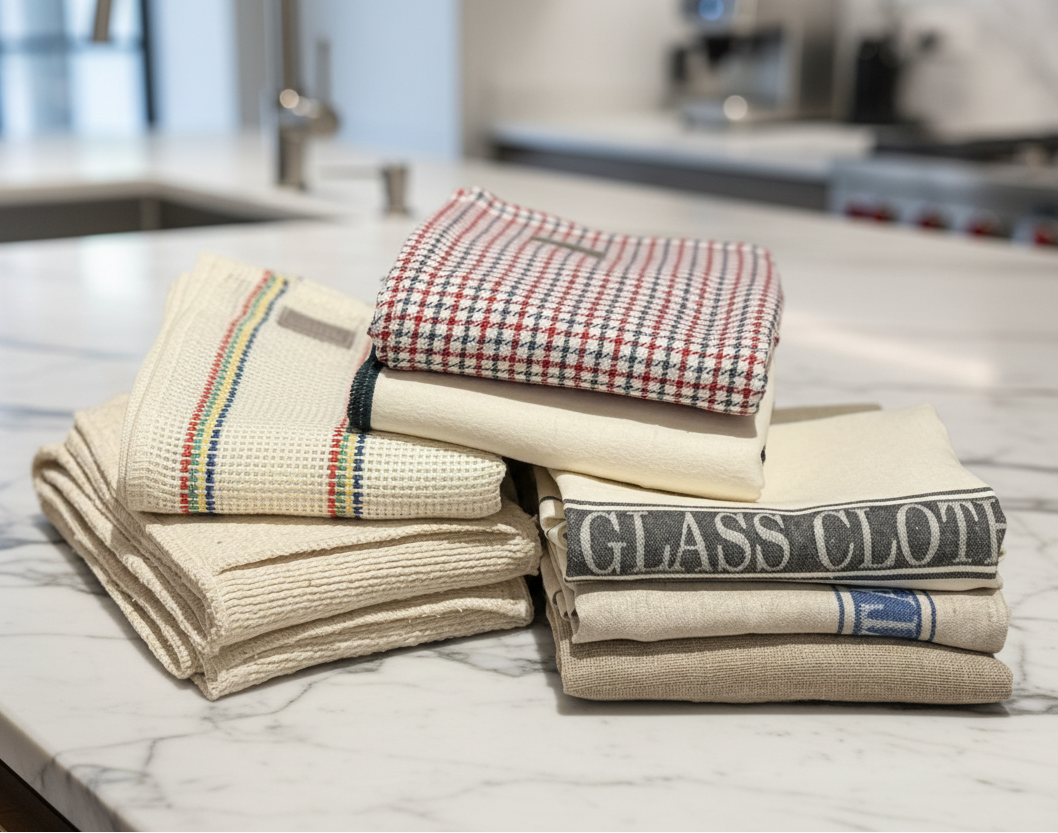
The Woods Fine Irish Linen Glass Cloth is 58cm by 75cm, which matters, because a small cloth is damp after four glasses. The stripe comes in red, blue, black or green.
What is the instant dryer for?
The end of a dinner party.
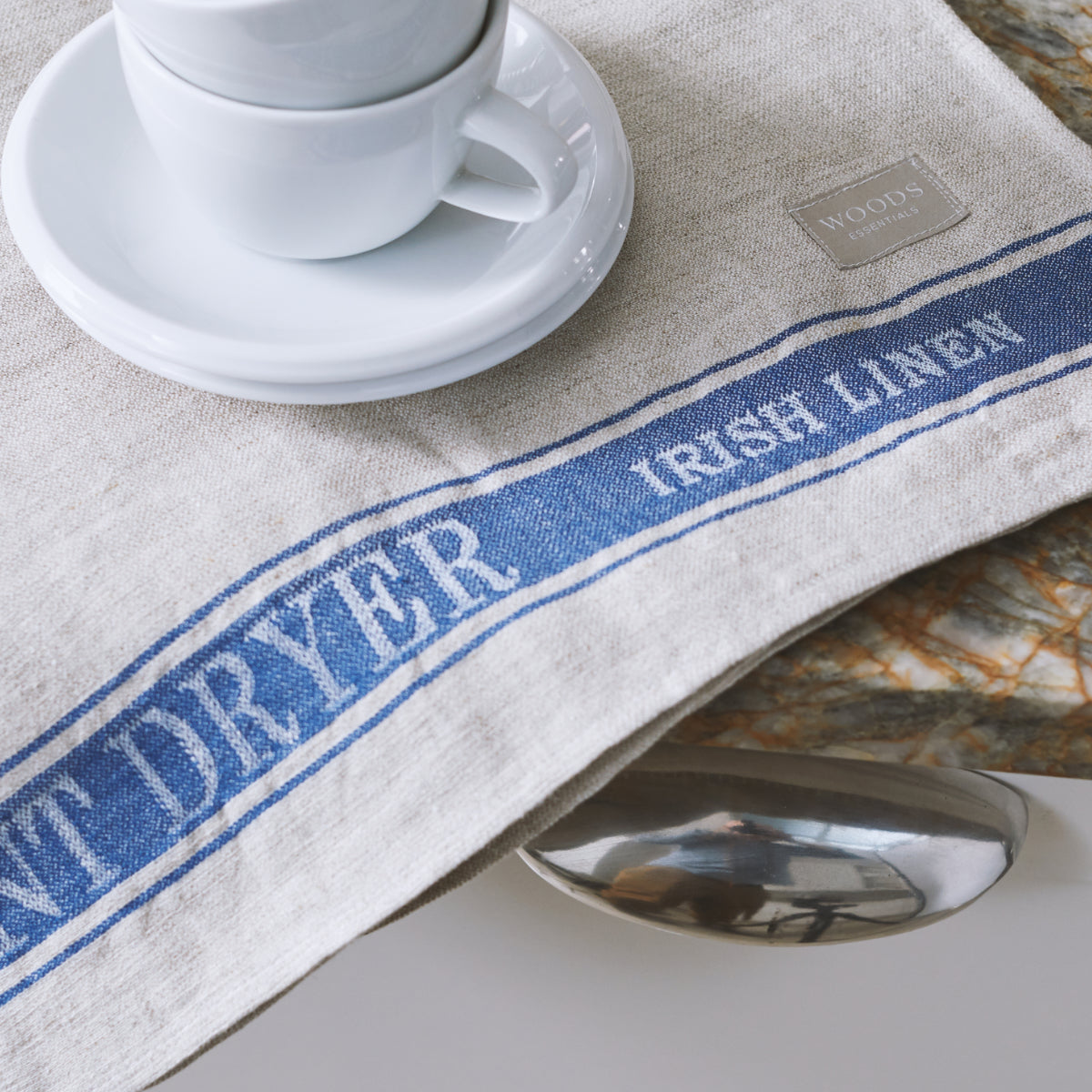
The Woods Irish Linen Instant Dryer is sold singly or in sixes. It is 75cm by 55cm, woven in Northern Ireland, and it arrives pre-washed, which is unusual and is the whole point. Linen normally needs three or four washes before it stops repelling water and starts absorbing it. This one is finished before it reaches you, so it works properly the first time you pick it up.
Its everyday counterpart is the Irish Linen Kitchen Cloth in black stripe at 72cm by 56cm. Also Irish linen, also made in Northern Ireland.
What is a duster actually for?
Polishing, and the answer is in the weave rather than the fibre.
The Cotton Twill Check Duster is 100% cotton in a twill weave, 50cm by 58cm, in the red and blue check that has been the same for generations. Twill means the yarns run diagonally rather than square, so they move against each other more freely, and that is what makes a duster soft and pliable enough to get into a moulding or round a bannister spindle without dragging. It is lint-free, and it resists going grey in the way an ordinary cotton cloth does.
Beside it sits the Woods Super Polisher Cloth, made from unbleached cotton in England, for buffing furniture, silver and ornaments. The Linen Window Cleaning Scrim is the one for glass, an open linen weave that leaves no smear on a window for the same reason a linen glass cloth leaves none on a wine glass.
These live in the cleaning cloths collection rather than with the kitchen linen, but they belong to the same argument. A duster at four pounds that lasts for years is not an expensive duster.
What is each cloth made of?
- The Woods Famous 100% Linen Dishcloth is 100% Irish linen, 46cm x 46cm, woven in Northern Ireland from line yarn rather than tow, and made exclusively for Woods for over 100 years.
- The Woods Fine Irish Linen Glass Cloth is 100% Irish linen, 58cm x 75cm, made in Northern Ireland, with a coloured centre stripe so it is never used for another job.
- The Woods Irish Linen Instant Dryer is 100% Irish linen, 75cm x 55cm, made in Northern Ireland, and supplied pre-washed so it absorbs from first use.
- The Woods Irish Linen Kitchen Cloth is 100% Irish linen, 72cm x 56cm, made in Northern Ireland.
- Woods Traditional Cotton Double Oven Gloves are 100% unbleached cotton, 90cm x 16cm, made in England, and shrink 5 to 10% on first wash; the Traditional Oven Cloth is 46cm x 94cm, also made in England, and is 60% cotton, 25% polyester and 15% mixed fibres.
- The Cotton Twill Check Duster is 100% cotton, 50cm x 58cm, woven as a twill so the yarns move freely and the cloth stays soft enough to work into mouldings, and it is lint-free.
- Linen is more absorbent than cotton, which is why a flat linen glass cloth polishes glassware without the lint left by looped terry cotton.
- Line yarn is long combed flax; tow is the short waste fibre left after combing. Nearly all inexpensive linen cloth is tow.
Which of these are actually made in Britain?
Not all of them, and this piece would be dishonest if it implied otherwise.
Northern Ireland: the dishcloth, the glass cloth, the instant dryer, the kitchen cloth and the Harrogate tea towel.
England: the oven gloves and the oven cloth.
Elsewhere: the Terry Cotton Kitchen Tea Towel is woven in Portugal and the Cotton Twill Check Duster is made in India. Both are good cloths that we have sold for years. Neither is British, and saying otherwise would undo the argument this whole page is making.
What should actually be in the drawer?
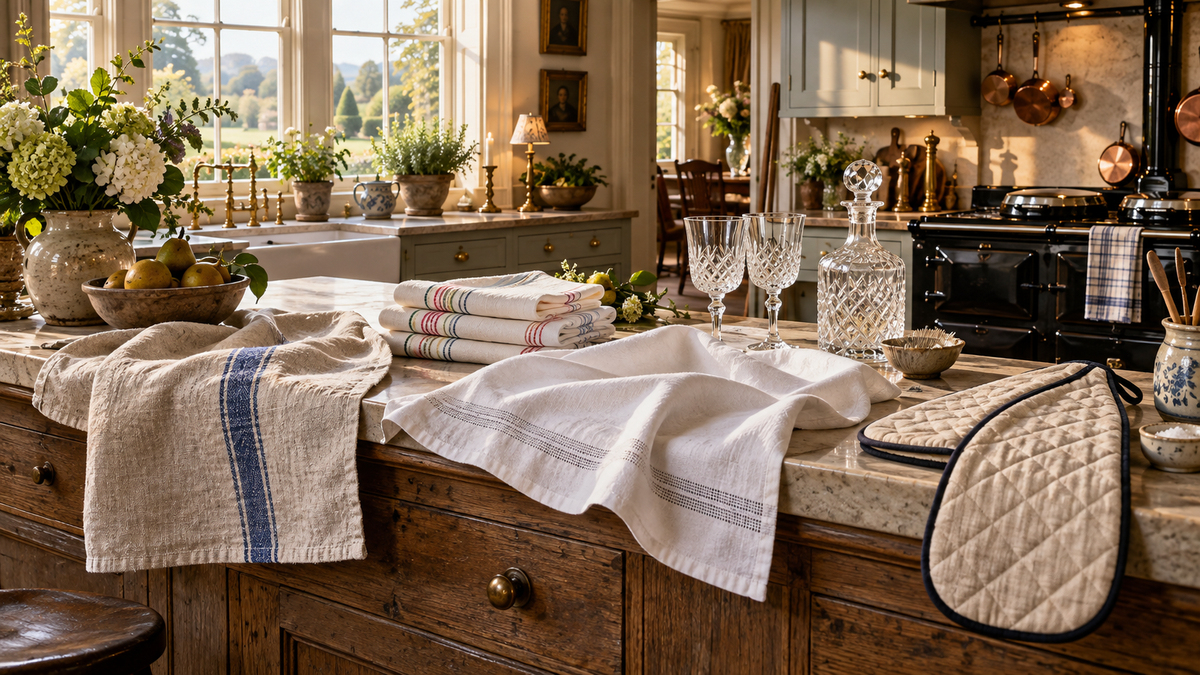
Three dishcloths in rotation, so one is always dry. Two glass cloths kept apart from everything else. One instant dryer for volume. Oven gloves or an oven cloth, depending on whether you would rather put your hands into something or hold it.
That is it, and it should last years rather than months. The economics are worked through properly in linen tea towels against cotton and microfibre, and Irish linen tea towels that actually perform covers how they behave day to day. Everything is in the kitchen linen collection, the tea towels and glass cloths and the cleaning cloths.
One more thing, and it is the reason any of this survived. Cloth made to these specifications only continues to exist while enough people go on buying it, which is the plain economics of keeping a mill going. If you want to be one of them, the Heritage Partnership is our mailing list for customers who care about keeping the British textile industry going. It brings two catalogues a year, first sight of new pieces and invitations to what we put on in Harrogate, and joining it does more to keep an Irish linen mill running than any amount of admiring the idea from a distance.
Who drew the Harrogate tea towel?
My grandfather.
"In about [the] 1950s, my father designed this Harrogate tea towel which may not be everybody's cup of tea but it is 100% linen. We had it reproduced for our centenary and that was 30 years ago now."
George Appleby Woods took the shop on in 1940 and ran it for twenty-five years. He drew the Harrogate District tea towel in 1952, a map of the district and the country around it, printed on Irish linen at 46cm by 71cm. He and my grandmother Thalia were killed in a car accident in 1965, and my father took the business on the following year, aged seventeen.
The Woods family has been associated with fine linen since 1733, and our Harrogate shop has traded since 1895. The full story is set out in our heritage timeline.
We reprinted the design for the centenary of the Harrogate shop, 1895 to 1995, and it has been in the range ever since.
I have always liked that my father calls it not everybody's cup of tea. He is right. It is busy, detailed and thoroughly unfashionable, and it has outlasted every fashionable thing we have ever hung beside it. People buy it because they were born here, or because they left, or because they want to give somebody a piece of Harrogate that is not a fridge magnet.
Wash it at 40°C before first use, do not tumble it, and iron it damp. It will see you out.