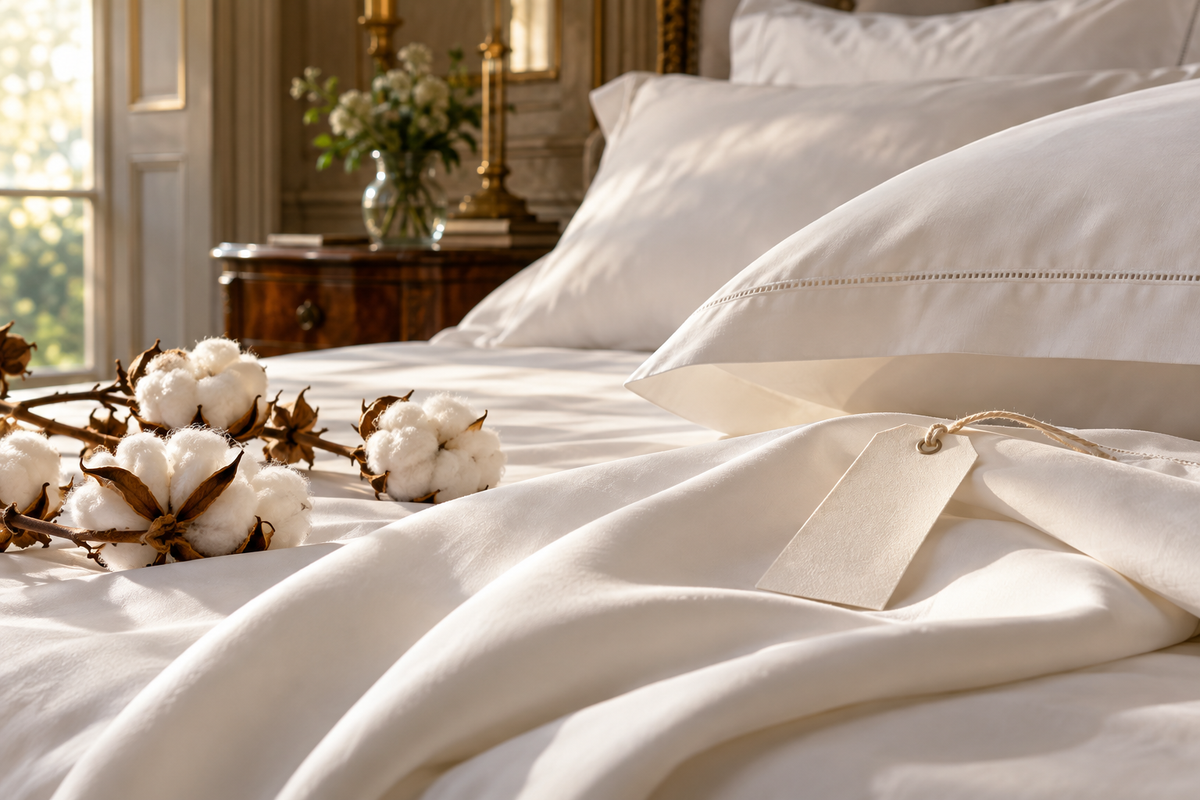
Egyptian Cotton Bedding: Why The Label Guarantees Nothing
Egyptian cotton is a statement of origin, not of quality. Cotton grown in the Nile Delta can be excellent or ordinary, and the label alone tells you neither. What decides how a sheet feels and how long it lasts is the grade of fibre, whether the yarn is single ply, the weave and the finishing.
- Egyptian cotton describes where the cotton was grown, not how good the sheet is.
- There is good and poor quality Egyptian cotton, so ask for good quality sheeting.
- Single-ply cotton is better to sleep under.
- The grade of fibre, the weave and the finishing decide how a sheet feels and how long it lasts.
- A high thread count can be inflated by counting twisted yarns separately.
What does the label actually promise?
Walk through any department store and the proposition is the same everywhere. Egyptian cotton means luxury. A higher number means better. Pay more, sleep better.
The first of those is a geographical claim doing the work of a quality claim, and it should not be allowed to.
Egyptian cotton means cotton grown in Egypt, predominantly in the Nile Delta. Those conditions do tend to produce long and extra-long staple fibre, which spins into finer, stronger, smoother yarn than short-staple cotton. That is a real advantage and it is why the name became worth something in the first place.
But the name describes a field. It says nothing about which grade of that field's crop was used, how finely it was spun, how tightly it was woven, or how carefully it was finished. Those four things happen after the cotton leaves Egypt, they are where nearly all the quality lives, and any of them can be done badly.
If your worry is whether the cotton is genuinely Egyptian at all, that is a different question and we answer it in how to spot authentic Egyptian cotton bedding. This page assumes it is genuine and asks whether it is any good.
So why is one Egyptian cotton sheet twice as good as another?
Because the crop is graded, and both grades keep the name.
The best of a harvest goes to mills that will pay for it, and is spun into fine single-ply yarn by people who know what to do with it. The remainder is still Egyptian cotton, spun more coarsely, woven more loosely and rushed through finishing. Two sheets, same two words on the packet, a real difference in how long they last.
My father William puts it simply:
"So even choosing Egyptian cotton isn't necessarily a measure of a good quality sheet. But you actually find good quality Egyptian cotton, poor quality Egyptian cotton, but do ask for good quality Egyptian cotton sheeting."
The useful part is the end: ask for good quality Egyptian cotton sheeting, not just Egyptian cotton.
Why should you take our word for it?
Fair challenge, since we are a shop and we are about to point you at things we sell.
"I used to actually work in linen mills in Northern Ireland for about six years. And we used to be linen weavers, of course, in the late 19th century. So I like to think we know a little bit what we're talking about."
After the mills came a buying career that took him across the States, Europe, Singapore and the Far East.
The Woods family has been associated with fine linen since 1733, and our Harrogate shop has traded since 1895, as our heritage timeline sets out. None of that makes a sheet good, but it does mean we have had a long time to see which ones last.
Does finishing matter more than fibre?
Not more. But far more than anyone tells you.
Finishing is everything between the loom and the packet. Singeing the surface fuzz off. Washing. Mercerising. Calendering. How the cloth is dried, and how it is stabilised so it does not shrink into a different size the first time you wash it.
Two mills can start with identical bales and identical constructions and hand you cloth that feels nothing alike, because one took time over the finish and the other did not. A well-finished sheet at a modest count will feel better than a badly finished one with a bigger number, and you can feel it within a second of touching both.
Is a higher thread count better cotton?
No, and the number is easier to inflate than almost anything else on a label.
"I beg of you, please, please, do not be sucked into thread counts."
Thread count is threads per square inch. Twist several fine yarns together into one thread, count each strand separately, and the number on the packet can be far higher than the real count.
Our own highest counts are genuine: the Graziano Hemstitch , Graziano Notre Dame
and Woods Sorano Superfine are all 600 thread count percale.
My father explains how the figures get inflated in Does Thread Count? The Truth by William Woods.
What should you ask before you buy?
These are the questions we would want a customer to put to us, and to anyone else.
- Is the yarn single ply or multi ply? Single-ply cloth is better to sleep under, and a retailer who cannot answer this is not the retailer to buy from.
- Is the fibre long staple or extra-long staple? Longer fibre means fewer ends at the yarn surface, which means less pilling and a smoother hand that survives washing.
- Is it percale or sateen? Percale is a plain one-over-one weave, crisp and cool; sateen floats yarns across the surface for sheen, drape and warmth. Neither is better.
- What is the actual thread count, and is it counted per thread or per strand?
- Where was it woven and finished? Our Peter Reed percale is woven in England at 200 and 400 thread count; the Woods Murano, Aquileia, Udine and San Danielle sateens are 300 thread count and made in Italy.
- Has the shop handled the cloth themselves? Egyptian cotton describes where cotton was grown and nothing about how the finished sheet was made, so the only real protection is a buyer who has inspected it.
How do you judge it with your hands?
Hold it to a window. Good cloth is even. Light coming through in patches means irregular yarn and a loose weave.
Rub it between finger and thumb. You are feeling for fuzz. Properly singed and finished long-staple cotton feels smooth and slightly dry rather than fluffy. New bedding that feels like brushed cotton has a finish on it that will wash out inside a month, and what is left underneath is what you actually bought.
Look at the hem. Mills that care about cloth care about making up, and a cheap hem under an expensive claim tells you where the money went.
Then buy from someone who will answer the six questions above. Ours are in the Egyptian cotton bed linen collection, and if you are weighing whether the step up is worth it at all, when Egyptian cotton bedding is worth the investment takes that on directly. If it is the weave you are undecided about, we set the two side by side in percale or sateen.
Whether the cotton is Egyptian is only part of the picture. For the full checklist, from design and colour to choosing a reputable maker, read how to choose the best cotton sheets.
An Egyptian cotton label is where the conversation should start, not where it ends. Hold the cloth to the light, feel it between finger and thumb, look at the hem, and ask the questions the packet cannot answer. A good sheet will stand up to all of it. If you would like to put those questions to us, in the Harrogate shop or online, we would be glad to answer them, and you can stay in touch with us through the Heritage Partnership.