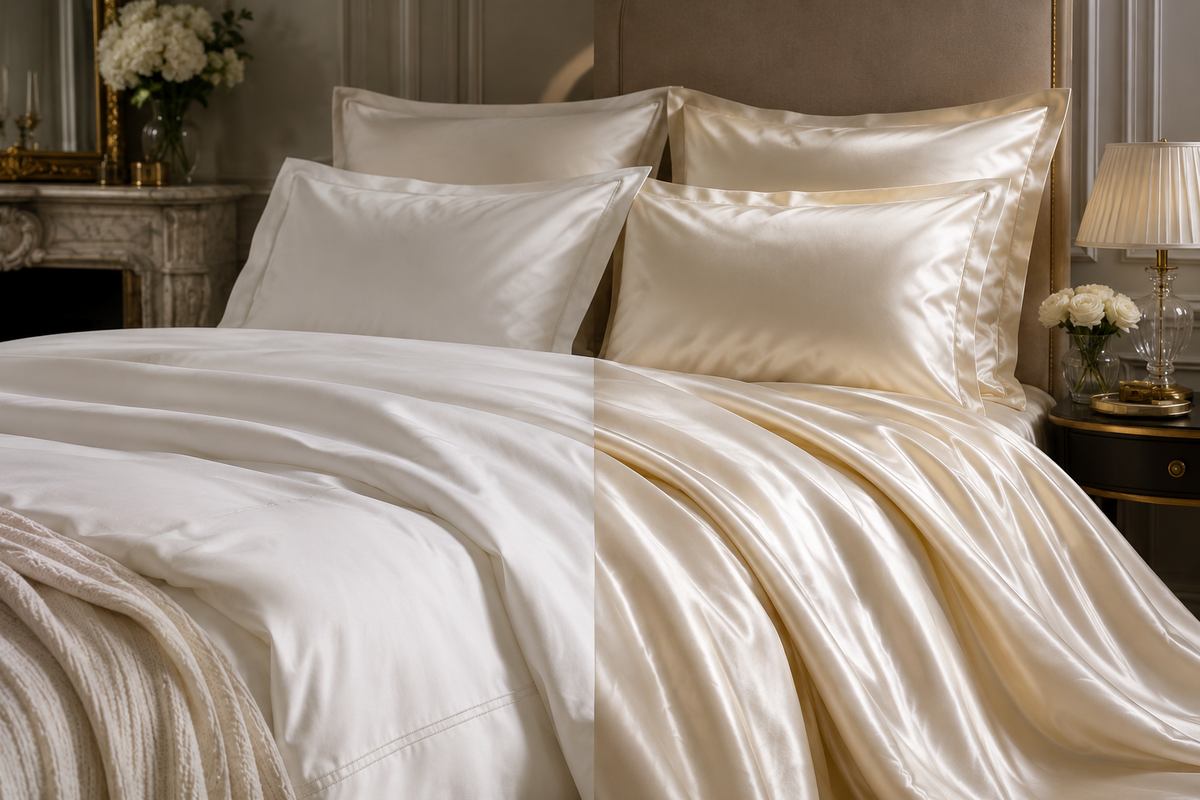
Percale or Sateen? We Sell an Equal Number of Both
Percale and sateen are weaves, not materials, and neither is better. Percale is a plain one-over-one weave that feels crisp and cool. Sateen floats yarns across the surface for a smoother, warmer, more lustrous cloth. We sell an equal number of both, which is the most honest answer anyone can give you.
- Percale is a plain one-over-one weave with a crisp, cool feel; sateen floats yarns across the surface for a smoother, more lustrous finish.
- Woods sells an equal number of percale and sateen.
- Percale is my father's own choice, at 180 threads per square inch or over.
- Cotton sateen tends to be easier to iron than percale.
- The Graziano Hemstitch, Graziano Notre Dame and Sorano Superfine are 600 thread count percale.
- The Woods Murano, Aquileia, Udine and San Danielle are 300 thread count sateen, made in Italy.
Which weave do we sell more of?
Neither. It is an even split.
"Otherwise, you might choose cotton sateen. You can still have Egyptian cotton sateen. But that tends to be a much silkier feel to the sheet which many people prefer. We sell an equal number of both."
Those are my father's words. Roughly half our customers want a crisp bed and roughly half want a smooth one, and the most useful thing we can do is help you work out which half you are in before you spend the money. The Woods family has been associated with fine linen since 1733, and our Harrogate shop has traded since 1895, which our heritage timeline sets out properly.
So this page is not going to recommend one. It is going to give you four straight comparisons and let you decide.
Are they different fabrics, or the same cloth woven differently?
The same cloth, woven differently, and getting this wrong is what costs people money.
Egyptian cotton, Giza, Supima, linen: those are fibres. Percale and sateen are what a mill does with the fibre once it reaches the loom. You can buy Egyptian cotton in either.
So there are two questions, and most people only ask one. What is the cloth made of, and how well was it made? That is the bigger of the two and we take it apart in why the Egyptian cotton label guarantees nothing. Only once that is settled does the weave question matter. A beautifully woven sheet made from poor yarn is still a poor sheet.
Which one is cooler in July?
Percale, and not marginally.
In a percale the weft thread passes over one warp thread and under the next, all the way across. That regular over-under leaves small air spaces throughout the cloth, and those spaces are what let heat and moisture move. You feel it the instant you get into the bed: a coolness that is almost startling on a warm night.
Sateen floats yarns instead, typically one passing over three or four before going under. More yarn sits on the surface, less air sits in the structure, and the cloth holds warmth. In a cold Yorkshire bedroom in January that is exactly what you want. In a south-facing room in July it is not.
If you are the person who has one foot out of the covers by two in the morning, that is the whole decision and you can stop reading.
Which one creases, and does it matter?
Percale creases. Sateen does not, much.
This is the honest trade against the coolness. A plain weave in a natural fibre will crumple, and a percale bed that has not been ironed looks slept in even when it is not. That is either a charming lived-in quality or an irritation, and only you know which.
If ironing is not going to happen in your house, be honest about that now and buy sateen.
Which one lasts longer?
In good cotton, both, for decades. In poor cotton, percale.
Those floating yarns that give sateen its sheen also sit exposed on the surface of the cloth, where they take the abrasion. In long-staple Egyptian cotton the fibre is strong enough that this rarely becomes a practical problem in a lifetime of use. In a short-staple cotton it does, and a cheap sateen will pill long before a cheap percale.
Which is another way of saying that the fibre question outranks the weave question, again.
Both last longer in rotation, and neither wants fabric conditioner, which coats the fibre and takes away the breathability you paid for. Our guide to bed linen care labels has the temperatures.
How many threads should percale have?
My father gives a number:
"...percale, which has a nice crisp feel to it, which is basically a thread count of 180 threads per square inch or over, has a lovely feel, and that's my personal choice."
The 180 is his figure, and the last part is his own preference, not a rule for anyone else.
The Graziano Hemstitch and Graziano Notre Dame are 600 thread count percale, and so is the Sorano Superfine. My father's article Does Thread Count? The Truth by William Woods explains how thread counts are reached.
So which one are you?
- Choose percale if you sleep hot, kick the covers off, like a taut bed, or have ever described a hotel bed as the best night you have had.
- Choose sateen if you run cold, want a bed that feels enveloping, like a little sheen in the room, or know you will not iron.
- Choose sateen if the bed is in a room people see, because it photographs and drapes better than percale ever will.
- Choose both and rotate if you have the storage, percale from May to September and sateen from October to April, since a British year is really two climates.
- Ignore the weave entirely until you have settled the fibre, because a well-finished 200 thread count sheet beats a badly finished 400 in either weave.
- Do not use fabric conditioner on either, because it coats the fibre and reduces the breathability that distinguishes them.
Where should you actually decide?
In the shop, with your hands.
Thirty seconds of touching both will tell you more than this page has, and it is the one thing an online-only retailer cannot offer you. Come into Harrogate, ask for both, and hold them. You will know within a few seconds.
If that is not practical, start with percale from the Peter Reed 5 Row Signature Cord at 400 thread count, woven in England, or the 2 Row at 200. For sateen, the Woods Murano, Aquileia, Udine or San Danielle, all 300 thread count and made in Italy.
And if you want percale explained properly on its own terms first, why cotton percale is synonymous with luxury bed linen does that job.
If you would like to hear about new bed linen, the Heritage Partnership is our maiiling list, and you would be very welcome to join it.