
Egyptian Cotton Towels: Absorbency, Weight and Care That Actually Works
Choose a towel by how well it dries you and how long it lasts, not by its GSM alone. Between 500 and 600gsm suits most bathrooms, and nothing below 500 is worth buying. Above that you are paying for plushness rather than performance, unless the cotton and the construction are genuinely better.
The number on the label is the least useful thing about a towel
My father has been asked what to look for in a towel more times than either of us could count, and he has never once started with the weight. He started in the trade working for a towel manufacturer in Northern Ireland, and spent a buying career after that going to the States, Europe, Singapore and the Far East looking for what was different and what was best.
His view on GSM is the same as his view on thread count, and he does not soften it:
"There is a lot of nonsense taught about thread counts in cheating. And so the same is true of grammes per square meter in towels, and everything hinges on the quality of a towel by its weight, which is not true."
A dense towel made from mediocre cotton is a heavy, mediocre towel. Weight is one input alongside the grade of the cotton, the length of the staple, the construction of the pile and the finishing. Get those right and the weight follows. Get them wrong and no amount of weight will save it.
So what weight should you actually buy?
"Generally speaking, in the main, somewhere between 500 and 600 is where you should be looking at. Certainly nothing less than 500."
That is the everyday range and it is the one most people should be in. Absorbent enough to dry you properly, light enough to dry itself between uses, which matters more than people expect in a bathroom without much ventilation.
Below 500gsm a towel will feel thin and you will reach for a second one. Above 600 you are into plushness, and whether that is worth paying for depends entirely on what the extra weight is made of.
Match the weight to the job as well. A bath sheet can carry more than a hand towel that gets used twenty times a day and needs to be dry again by evening.
Everything worth knowing, in short
- GSM measures the weight of a towel, not its quality, and a heavy towel is not automatically a better towel.
- Between 500 and 600gsm is the sensible range for most bathrooms, and below 500gsm a towel will struggle to dry you properly.
- Linen is more absorbent than cotton, though linen pile towels are rare because linen is difficult to weave as a pile.
- Waffle and huckaback towels dry you quickly and then dry themselves quickly, which makes them useful in humid bathrooms and in summer.
- Cropped or velour towels have a cut pile, which looks handsome but does not absorb as well as a looped pile.
- Carded cotton feels rougher than Egyptian cotton but stands up to heavy laundering, which is why hotels use it.
- Egyptian cotton describes where the cotton grew, not how good it is. There is good Egyptian cotton and poor Egyptian cotton.
- A new Egyptian cotton towel needs two or three washes before it reaches full absorbency.
- Fabric softener coats the fibres and reduces absorbency, so a towel should never see it.
The types, and what each is actually for
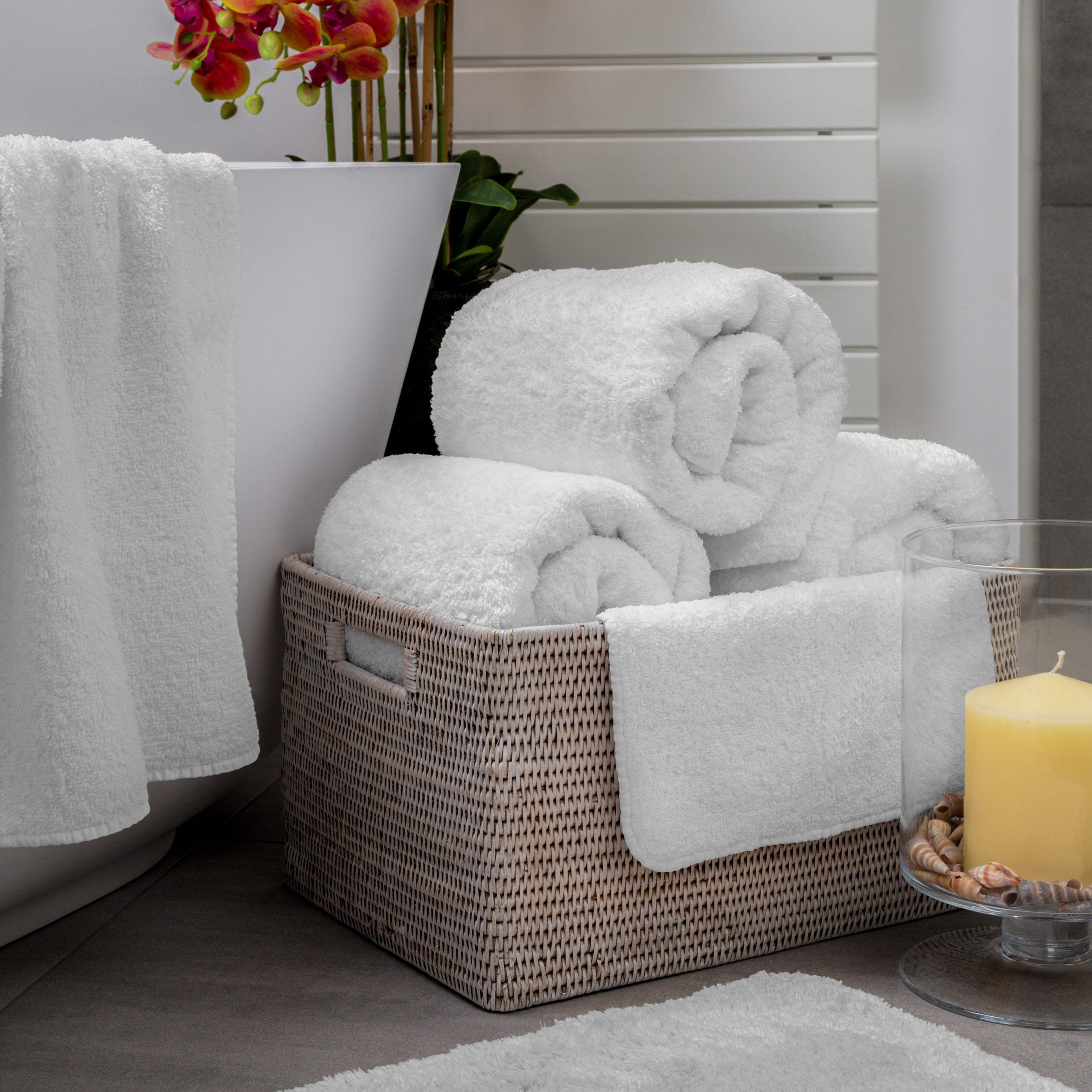
Terry towelling is the standard looped pile, and most towels in most bathrooms are this.
Carded cotton is a shorter staple, rougher in the hand and extremely durable. Hotels use it because it survives hard wearing, and once it has been washed regularly it becomes genuinely absorbent. If you want a towel that will outlast a family, this is not a compromise.
Egyptian cotton is longer staple and smoother, and makes a softer towel that still dries well when the grade is right.
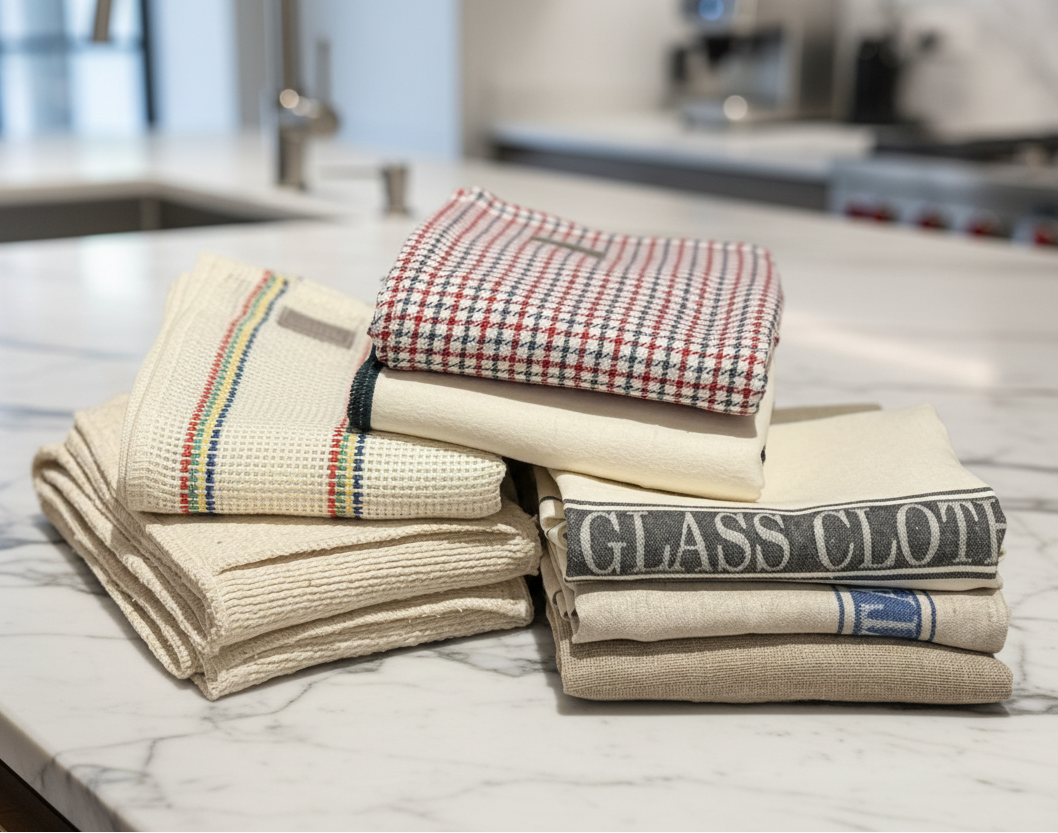
Waffle has a structured weave rather than a dense pile, so it dries you and then dries itself quickly. Popular on the continent, and worth having alongside terry rather than instead of it.
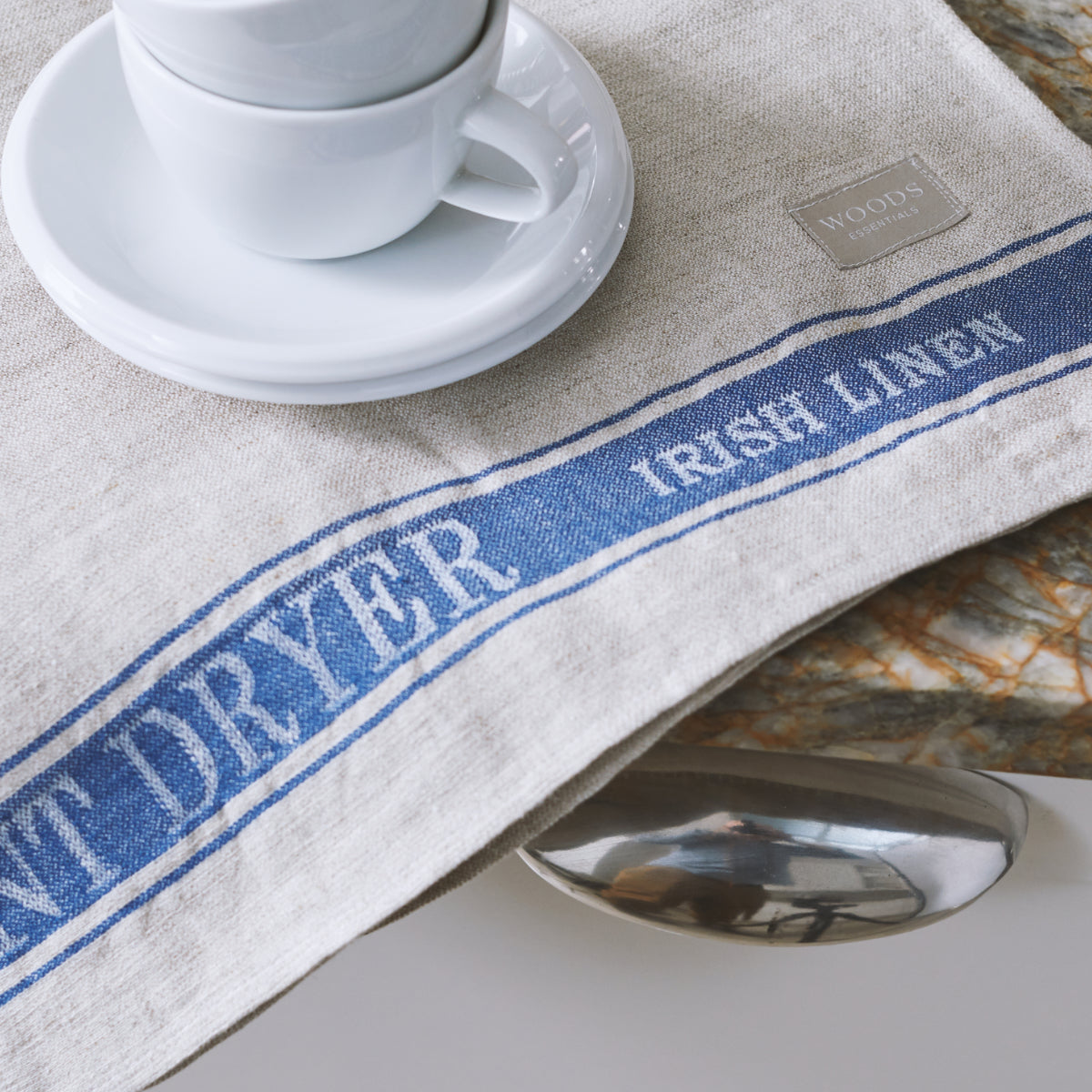
Linen huckaback is the traditional Irish linen towel, made in Northern Ireland for generations. Very absorbent, dries fast, gets wet fast.
Cropped or velour have a cut pile, like velvet. They look excellent and they do not absorb as well, so you end up drying yourself on the reverse. Buy them knowing that.
Why is linen so rarely used for towels?
Because it is difficult to weave as a pile, not because it does not work.
"Linen is more absorbent than cotton, but you don't actually often see linen pile towels."
We had one made for us, the linen friction towel, with a cotton back and a linen pile. It is very absorbent, and because the linen in the pile is natural and undyed it lightens over time rather than staying exactly as it left the shop. That is the material behaving as it should rather than a fault.
The rub test, the water drop test and the twist test
Every towel that comes into the shop goes through all three. The rub test is for how the pile holds up. The water drop test is for whether the towel takes water in or beads it on the surface. The twist test is for whether the yarn and construction hold together under stress.
It is a small shop's way of doing things and it is why the range is narrower than it might be. It is also the part I would point at if you are comparing us with somewhere larger.
The towel my father would not sell without a guarantee
The Ultimate Supreme exists because a towel he admired stopped being made.
"I've seen the decline of the British textile business in the 1980s, which I've talked about before, but there was one particular towel that I was very, very fond of, and it's long gone, made by a British manufacturer, and it's long gone. And it's been my mission for the last two or three years to produce a towel that matches that."
It is 700gsm, double looped, in the finest Egyptian cotton. He is confident enough about it to break a rule most retailers would not go near:
"If you're not happy with it, send it back. I don't care whether you've had it for many months. If you're not happy, I don't want you to have it."
Used, washed, months old. There are not many towels sold in this country on those terms.
One caveat he gives himself on camera: an Egyptian cotton towel of that weight takes two or three washes before it starts absorbing properly. Judge it after the third wash, not out of the wrapper.
He is also bringing back the swan. Barlow and Jones wove towels under the Osman name and made one with swans on it, and it is in production now with a scalloped edge. He has wanted it back for years.
One instruction that matters more than the rest
Wash at 40°C, do not bleach, tumble dry on a normal setting. And never use fabric softener.
That last one comes from our Did You Know series, in which my father sits down with Andrew Bean, who has been with us for twenty two years and was at Harvey Nichols and Harrods before that:
"Hotels rarely use fabric conditioner on their sheets. Fine cotton softens naturally with washing and fabric softener reduces the breathability."
It applies to towels more than anything else. Softener works by coating the fibres in a waxy layer, which is precisely what stops a towel taking up water. A towel that has gone slightly slick, or stopped drying you, has usually been conditioned rather than worn out. Several washes without it will normally bring it back.
Cotton softens on its own. Give it time and leave the conditioner out.
Where to look next
The full range is in our towels collection. If you are pairing towels with bed linen, my father's view on thread count follows exactly the same logic.
If you would like more of this, our mailing list is the Heritage Partnership. We use it for care advice, word when something we have had made comes back into stock, and the occasional note from my father on what he is having made and why. The swan towel will be announced there first.