

Blankets and Throws: How to Layer, Store and Replace Them
A blanket is a bed layer built for warmth. A throw is a smaller, lighter piece for a chair or the end of a bed. The real advantage of a blanket over a duvet is adjustability: you can take a layer off at three in the morning, which is something a single tog rating cannot do.
- A blanket is adjustable in a way a single tog rating is not: you add or remove a layer.
- The Woods Pure Merino blanket is 400gsm, the Pure Cashmere 375gsm and the Lambswool and Cashmere 215gsm.
- All four Woods wool blankets are woven in Yorkshire.
- The Pure Cashmere blanket is ordered in for each customer.
- Woods wool blankets are dry clean only, so everyday care means airing, brushing and storing them properly.
What did a British bed look like in the 1970s?
A fitted sheet, a flat sheet, and two or three wool blankets, with an eiderdown over the top if the house was cold. Very few people owned a duvet.
"It's difficult to imagine that back in the day, probably in the 1970s, everybody had blankets and sheets. They didn't have duvets and we were one of the first people to have duvets."
That is my father, and the duvet he describes went on to replace the blanket in most British bedrooms. Fitted sheet, one duvet, done.
It won on labour. A duvet bed takes ten seconds to make and a blanket bed takes two minutes, and multiplied by every morning of a life that is not a small thing.
What went with it was control. A blanket bed is a stack of independent layers you can add to or subtract from on any given night. A duvet is a single decision, made once in a shop, about how warm you will be every night until you replace it.
Why did the blanket come back?
Because the tog rating was always a compromise and people have stopped pretending otherwise.
A 10.5 tog duvet is too warm in September and not warm enough in January. The usual solution is to sweat through autumn and add a hot water bottle in February. The better one is a lighter duvet with a wool blanket over it: in October the blanket is folded at the foot of the bed, in December it is over you, in February there are two.
There is also the plain fact that a good wool blanket, looked after properly, can last for decades.
What is the difference between merino, lambswool and cashmere?
Different animals, different shearings, genuinely different behaviour.
Merino comes from the merino sheep and is prized for its fine, soft fibre.
"...merino comes from wool from Australia, which is a quality we sold for 50 years in my lifetime."
Our records put the fibre in the Woods Pure Merino Wool Luxury Blanket as coming from Australian and New Zealand flocks, so Australia is one source rather than the only one. It is woven in Yorkshire at 400gsm with a satin binding, and it is the heaviest blanket we make. This is the one to buy if you want to be warm rather than to look as though you might be.
Lambswool is the first shearing from a young sheep, so the fibre tips have never been cut. That makes it finer and softer than the same animal's later fleece. The Woods Lambswool and Cashmere blanket is 85% lambswool and 15% cashmere at 215gsm, woven in Yorkshire, satin bound and finished by hand. At roughly half the weight of the merino it is the year-round choice.
Cashmere is not sheep's wool at all. It is the fine undercoat of the cashmere goat, combed out rather than shorn, and a single goat yields very little in a year, which is the whole explanation for the price.
We do not keep the Woods Pure Cashmere Luxury Blanket on the shelf, and we would rather say so than pretend otherwise. It is 100% cashmere at 375gsm, woven in Yorkshire and bound in satin or pure silk, and we order it in for the customers who want one. If it is what you are after, ask us and we will get it.
What do the numbers actually mean?
Buy on gsm rather than on adjectives, and the choice becomes simple.
- The Woods Pure Merino Wool Luxury Blanket is 100% merino wool at 400gsm, woven in Yorkshire, with fibre from Australian and New Zealand flocks. It is a proper winter blanket and can replace a duvet if layered.
- The Woods Lambswool and Cashmere blanket is 85% lambswool and 15% cashmere at 215gsm, woven in Yorkshire, and at roughly half the merino's weight it is the one blanket that works in every month of the year.
- The Woods Pure Cashmere Luxury Blanket is 100% cashmere at 375gsm, woven in Yorkshire and bound in satin or pure silk, and is ordered in to request rather than held in stock.
- Around 215gsm is a year-round weight and 375 to 400gsm is a proper winter blanket, so the lambswool and cashmere is the one to buy if it has to work in every month.
- Every Woods wool blanket is dry clean only, so routine care means airing, brushing and correct storage rather than washing.
- Throws run from roughly 105 x 165cm to 170 x 210cm, enough for a chair or a sofa.
Is a throw just a small blanket?
No. A blanket is bedding and a throw is furniture.
That distinction explains why they are rarely interchangeable. A throw is finished to be looked at, because it spends its life visible: over the arm of a sofa, across the foot of a made bed, round somebody in a chair. A blanket spends most of its life in the dark under a bedspread.
Size settles it. A throw runs from roughly 105 by 165cm, which is one person in a chair, up to around 170 by 210cm, which will cover two on a sofa. The Whittington mono waffle throw sits in the middle of that at 160 by 165cm, in 100% Shetland wool made in England. It is suitable for indoor or outdoor use, which matters if the thing is going to live on a sofa that gets used rather than looked at.
Buying a throw to fix a cold bed is the common mistake. There is simply not enough of it.
How should the layers go?
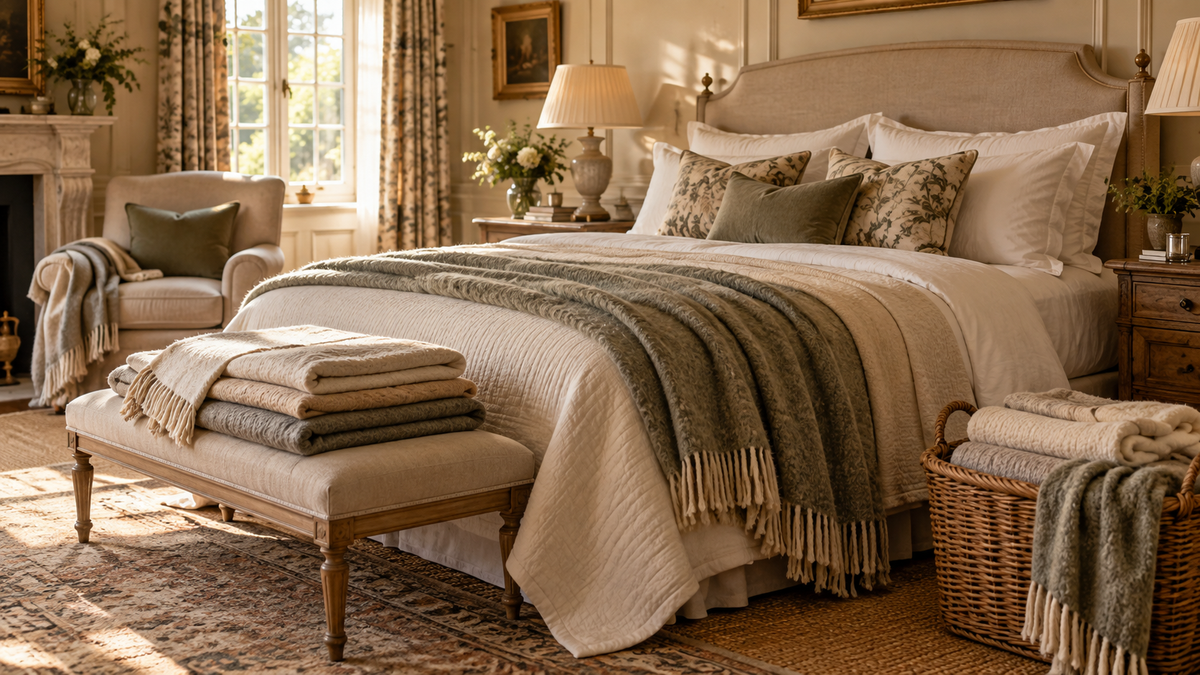
Fitted sheet, flat sheet if you use one, duvet, then the blanket over the duvet, then a throw folded across the foot.
The blanket goes over the duvet rather than under it, because its job is to trap the air the duvet has already warmed. Under it, it does almost nothing.
Tuck it in at the foot and the sides and leave the top edge loose, so the layer you want gone at three in the morning comes off from the top without unmaking the bed.
Keep the colours related rather than matched. A camel merino over ivory linen with a throw in a deeper tone reads as considered; three items in identical ivory reads as a hotel, and not a good one. If a bedspread is going into the arrangement too, our seasonal guide to layering a bedspread with duvets and blankets works through the order.
Do you ever wash a wool blanket?
Almost never. Every one we sell is dry clean only, and the great majority of blanket care is not washing at all.
Air it. An hour over a bannister or on a line on a dry, breezy day removes most of what makes a blanket smell lived in. Keep it out of long spells of direct summer sun, which fades wool.
Brush it with a soft clothes brush, in one direction, to lift flattened pile and take off lint.
Store it clean, bone dry and folded rather than compressed, in a breathable cotton bag. Never a sealed plastic box: wool needs to breathe and trapped moisture is what brings moth and mildew. Cedar rather than mothballs. There is more in how to refresh a luxury blanket without washing it.
When is a blanket actually finished?
Much later than most people think, and the signs are specific.
It is finished when the weave has opened up so far that it no longer holds air, which you can see by holding it to a window. It is finished when felting or matting will not lift under a brush. It is finished when moth damage has gone past repair.
It is not finished because it has pilled, and it is not finished because it is stained, which is what dry cleaning exists for.
A good wool blanket, aired properly and stored properly, will last for decades. That is the entire argument for buying one well instead of three cheaply, and you can see the range in the blankets and throws collection.
Our Merino, Lambswool and Cashmere, Pure Cashmere and Cellular blankets are all woven in Yorkshire, and the cashmere is ordered in for each customer, so it is worth asking early if you would like one before the cold sets in. The Heritage Partnership, our mailing list, is the easiest way to keep up with what is new.